

- March 1, 2026
- byDCN ServTech Team
- Boiler Tips & Advice
Your boiler works hard every day to heat your home and provide hot water — so it’s easy to take it for granted until something goes wrong. The problem is, many homeowners ignore the early warning signs of a failing boiler until it breaks down completely, often at the worst possible time.
At DCN ServTech, we carry out boiler repairs across Croydon and South London every week. In our experience, most breakdowns could have been caught earlier if the homeowner had known what to look for. Here are seven warning signs that your boiler needs professional attention — and what each one could mean.
1. Strange Noises Coming From the Boiler
A healthy boiler should operate relatively quietly. If you’re hearing banging, whistling, clunking, or gurgling sounds, something isn’t right.
Banging or clunking usually points to a process called kettling. This happens when limescale or sludge builds up on the heat exchanger, restricting water flow and causing the water to overheat and steam. It’s particularly common in hard water areas of South London. Left untreated, kettling can damage the heat exchanger — one of the most expensive components in the boiler.
Whistling (sometimes described as a “kettle boiling” sound) can also indicate kettling, or it may be caused by trapped air in the system or a failing pump.
Gurgling usually means there’s air trapped in the system, often in the pipes or radiators. While bleeding your radiators might resolve it, persistent gurgling after bleeding suggests a more significant issue.
If your boiler is making any unusual sounds, it’s worth getting a Gas Safe engineer to diagnose the cause before it leads to a more expensive repair.
2. The Boiler Keeps Losing Pressure
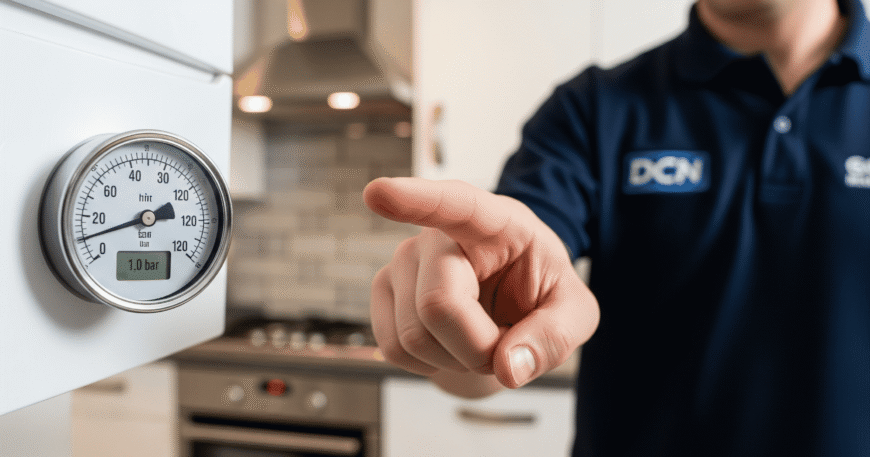
Your boiler’s pressure gauge should normally sit between 1.0 and 1.5 bar. If you find yourself constantly topping up the pressure using the filling loop, there’s likely a leak somewhere in the system.
Common causes of pressure loss include a leaking radiator valve, a small crack in the heat exchanger, a faulty pressure relief valve, or a leak in the pipework that may be hidden behind walls or under floors.
Topping up the pressure once in a while is normal — the system naturally loses a small amount over time. But if you’re doing it more than once a month, call an engineer to find and fix the leak.
3. The Boiler Keeps Cutting Out or Locking Out
Modern boilers have built-in safety mechanisms that shut the boiler down if something isn’t operating correctly. If your boiler frequently locks out (shows an error code and stops working), it’s telling you there’s a fault that needs addressing.
Common causes of lockouts include low water pressure, a blocked condensate pipe (very common in cold weather), a faulty ignition lead or electrode, a broken pump, or a failing PCB (the boiler’s electronic control board).
Some lockouts can be resolved by resetting the boiler, but if you’re resetting it more than occasionally, don’t ignore it. Repeated lockouts mean there’s an underlying fault that will only get worse.
4. Radiators Aren’t Heating Up Properly
If some of your radiators are cold at the top, cold at the bottom, or not heating up at all while others work fine, the issue is usually within the central heating system rather than the boiler itself — but the two are closely linked.
Cold at the top: Usually trapped air. Bleeding the radiator should fix it.
Cold at the bottom: This typically means sludge (a mixture of rust and debris) has settled at the bottom of the radiator, blocking water flow. A powerflush can clear this out and restore even heat distribution across the system.
Some radiators completely cold: This can indicate a faulty motorised valve, a stuck thermostatic radiator valve (TRV), or a circulation problem with the pump.
If bleeding your radiators doesn’t solve the problem, it’s time to call a heating engineer.
5. You Can Smell Gas or Notice a Yellow Flame
This is the one you absolutely must not ignore. A healthy gas boiler produces a crisp blue flame. If the flame has turned yellow or orange, it could indicate incomplete combustion — which means the boiler may be producing carbon monoxide.
Carbon monoxide is colourless and odourless, making it extremely dangerous. Other signs of a potential carbon monoxide issue include dark staining or soot marks around the boiler, excessive condensation on windows in the room where the boiler is located, and the pilot light frequently blowing out.
If you smell gas or see a yellow flame, take these steps immediately: open windows and doors to ventilate the area, do not use any light switches, matches, or electrical devices, turn off the gas supply at the meter if it’s safe to do so, leave the property, and call the National Gas Emergency Service on 0800 111 999. Once the immediate danger is dealt with, call a Gas Safe registered engineer to inspect and repair the boiler before it’s used again.
Every home with a gas boiler should have a working carbon monoxide alarm fitted in the same room as the boiler. If you don’t have one, fitting one is inexpensive and could save your life.
6. Your Energy Bills Are Rising for No Obvious Reason
If your gas bills have been creeping up but your usage hasn’t changed, your boiler’s efficiency may be declining. Boilers lose efficiency as they age, particularly if they haven’t been regularly serviced. A boiler that was running at 90% efficiency when new could drop to 70–75% after 10–15 years, meaning you’re paying to heat water that’s being wasted.
Sludge buildup in the system, a failing pump, or a deteriorating heat exchanger can all force the boiler to work harder (and burn more gas) to produce the same amount of heat.
An annual boiler service can help maintain efficiency and catch declining performance before it hits your wallet. If your boiler is older than 12–15 years and your bills are rising, it may be more economical to invest in a new, energy-efficient replacement.
7. The Boiler Is Leaking or Dripping
Any water coming from your boiler is a problem that needs investigating. Leaks can originate from a range of components — the pressure relief valve, internal seals, the heat exchanger, or pipe connections.
A small drip may seem minor, but left unchecked it can cause water damage to surrounding walls, floors, and electrics. In the worst case, water ingress into the boiler’s electrical components can cause a complete breakdown and make the boiler unsafe.
Never try to fix a boiler leak yourself. Turn off the boiler, catch any dripping water in a bucket, and call a Gas Safe registered engineer.
When to Repair vs When to Replace
Not every fault means you need a new boiler. Here’s a quick guide:
Repair makes sense when the boiler is less than 8–10 years old, the fault is isolated (a single component failure), and the repair cost is reasonable relative to the boiler’s remaining lifespan.
Replacement makes more sense when the boiler is over 12–15 years old, you’ve had multiple repairs in the past year, replacement parts are becoming hard to find, or the repair would cost more than a third of a new installation.
If you’re unsure, we’re happy to give you an honest assessment. We’ll never recommend a replacement when a repair will do the job.